
Ella Adams
State House News Service
The Senate has no appetite to raise taxes, Senate President Karen Spilka declared Tuesday as she emphasized her distaste for a proposed income tax cut initiative petition.
Asked whether she's open to any kind of tax policy changes in the budget the Senate is expected to pass next week, Spilka referred to "a significant change in tax policy" via a provision within a recent surtax supplemental spending bill that would get rid of the sales tax for certain construction materials.
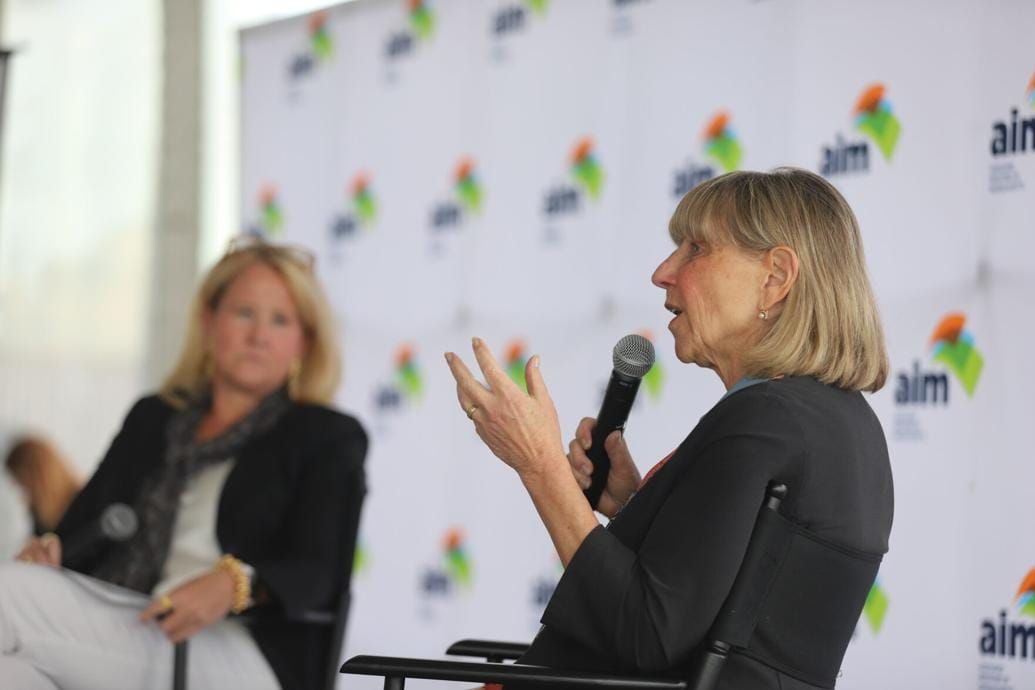
"We're trying to look at creative ways to get things moving even faster, but you know, we're not — raising taxes and fees is not on the Senate's horizon right now," Spilka told reporters after giving remarks at an Associated Industries of Massachusetts event at the New England Aquarium.
Several amendments to the Senate Ways and Means Committee's fiscal 2027 budget (S 4) relate to tax policy. Some Republican-filed amendments would lower taxes. An amendment from Democrat Sen. Becca Rausch (#846) would go the other direction and increase the state's corporate tax rate.
Speaking to the initiative petition that would lower the state income tax rate from 5% to 4% over three years, Spilka said the proposal "takes a sledgehammer to the process that is better off being finely tuned with a scalpel."
Justices of the Supreme Judicial Court seemingly found some fault with the summary connected to the tax cut proposal when hearing oral arguments in a court challenge last week. Spilka said she hopes the SJC rules that the petition does not go further, noting that "there was a lot that was not included in the summary" written by Democrat Attorney General Andrea Campbell.
"The administration recently came out with additional concerns — the charitable deduction would be gone because it's tied to the income tax. And S-corp businesses, small business taxes would go up. Not exactly what you want, or we want to happen in Massachusetts," Spilka told a room full business industry representatives.
A Healey administration analysis found that the charitable deduction approved by voters in 2000 would become unavailable to taxpayers beginning Jan. 1, 2028 if the income tax cut petition becomes law. The administration also said its passage would trigger an existing state law to automatically increase in the tax rate paid by businesses organized as larger S corporations.
"Nobody, I don't think, intended for that to happen," Spilka said. "But it's a perfect example of why -- I know it's frustrating and slow for bills to come through the Legislature. But we, as I said, meet with all stakeholders and advocates, talk to people, get different perspectives to make sure and hope what we pass not only makes sense but is feasible, practical, with no or the least amount of unintended consequences."
Asked if she's open to some sort of negotiated compromise with petition proponents if the SJC rules that the question can go forward, Spilka said, "Talk to me when that — if that happens."
Her chamber already killed the initiative petition that would have reformed the legislative stipend system. Proponents of that measure said they will be back in 2028 in a bid "to eliminate stipends altogether."
"I don't understand it. But they certainly have the right to do that," Spilka said when asked for her thoughts on the stipends campaign.