
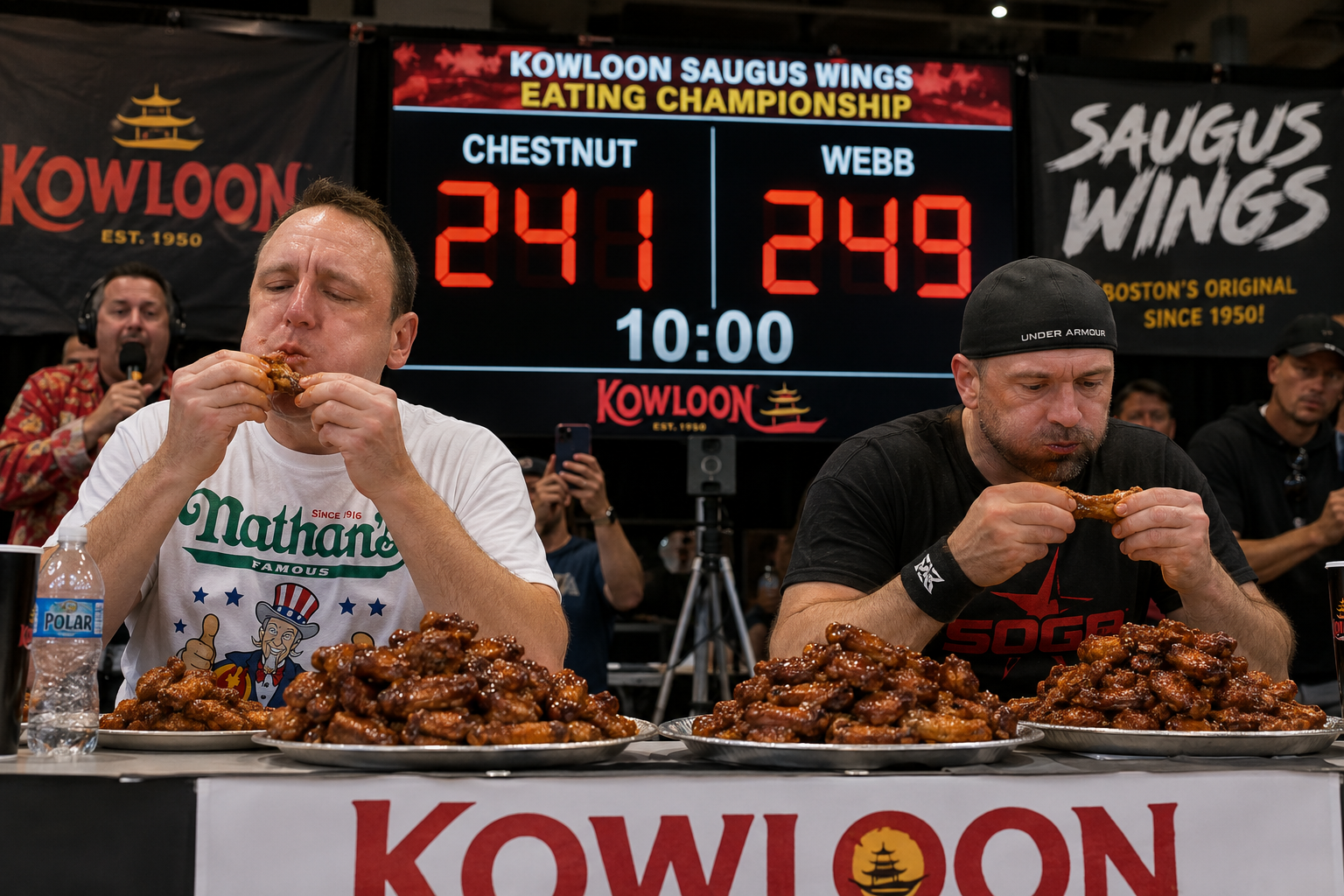
Fresh off winning his 18th Nathan's Famous Hot Dog Eating Contest championship, competitive eating legend Joey Chestnut made another stop in New England. This time, the challenge wasn't hot dogs, it was one of Massachusetts' most famous foods: Kowloon's legendary Saugus Wings.
The event drew national attention, not only because Chestnut was competing, but because it celebrated a restaurant that has become part of Massachusetts culture for generations.
Although Chestnut turned in an astonishing performance, it wasn't enough to capture first place.
Who Won the Kowloon Wings Eating Championship?
At the inaugural Kowloon Saugus Wings Eating Championship, held at The Brook in Seabrook, New Hampshire, Australia's James Webb defeated Joey Chestnut by one of the narrowest margins in recent competitive eating history.
Final Results
| Competitor | Wings Eaten | Time |
|---|---|---|
| James Webb | 249 | 10 Minutes |
| Joey Chestnut | 241 | 10 Minutes |
Chestnut averaged approximately one chicken wing every 2.5 seconds over the course of the competition.
For perspective, most people would struggle to finish 10 or 12 wings during an entire meal.
Why Kowloon Matters to Massachusetts
For anyone who has lived in Massachusetts, Kowloon needs little introduction.
Located in Saugus on Route 1, Kowloon has become one of New England's most recognizable restaurants. Since opening in the 1950s, it has welcomed millions of guests, hosted celebrities, politicians, athletes, and generations of Massachusetts families.
Its signature Saugus Wings have developed an almost cult following.
The sweet, garlicky, sticky sauce has become synonymous with Kowloon itself, making the wings one of the state's most recognizable restaurant specialties.
While the competition was held just across the New Hampshire border, the event was unmistakably about a Massachusetts institution.
How Many Wings Did Joey Chestnut Eat?
Joey Chestnut consumed 241 Kowloon wings in just 10 minutes.
That works out to approximately:
- 24 wings every minute
- One wing every 2.5 seconds
- Nearly 7.5 pounds of chicken
- More than 1,400 wings per hour if maintained (which, of course, no human could sustain)
Even more remarkable, 241 wings is only one wing short of Chestnut's personal best in wing competition.
The Science Behind Competitive Eating
Professional competitive eating isn't simply about having a large appetite.
Elite eaters spend years developing techniques that allow them to consume food at extraordinary speeds while minimizing fatigue.
Training often includes:
- Expanding stomach capacity safely over time
- Developing efficient chewing techniques
- Practicing controlled breathing
- Improving jaw endurance
- Cardiovascular conditioning
- Recovery protocols after competitions
During events, competitors must balance speed with precision. Losing even a few seconds can determine the outcome.
In the Kowloon championship, the difference between first and second place came down to only eight wings.
Joey Chestnut's Incredible Career
Despite finishing second, Joey Chestnut remains the most accomplished competitive eater in history.
Among his career accomplishments:
- 18 Nathan's Famous Hot Dog Eating Contest championships
- World record of 76 hot dogs and buns in 10 minutes
- Dozens of competitive eating world records
- Victories across foods including tacos, cheesesteaks, asparagus, chicken wings, and more
His consistency over nearly two decades has made him the defining athlete of professional competitive eating.
Why Competitive Eating Continues to Grow
Competitive eating has evolved from novelty entertainment into a global spectator sport.
Major competitions now attract international competitors, livestream audiences, sponsorships, television coverage, and millions of online views.
Fans are drawn to events because they combine athletic performance, strategy, humor, and foods people already recognize.
When the featured food is something as iconic as Kowloon's famous wings, interest extends well beyond competitive eating enthusiasts.
A Victory for Massachusetts Food Culture
Whether James Webb won the trophy or Joey Chestnut stole the headlines, the event accomplished something bigger.
It introduced one of Massachusetts' most beloved restaurants to a national audience.
For decades, Kowloon has been more than just a place to eat. It's a landmark woven into family traditions, celebrations, road trips, and the identity of Route 1 itself.
Seeing the world's greatest competitive eaters battle over a Massachusetts classic was another reminder that local institutions can still capture national attention.
Most visitors to Kowloon will probably stop after six or twelve wings.
After watching this competition, that suddenly seems like a very reasonable decision.
Frequently Asked Questions
Who won the Kowloon Wings Eating Championship?
Australian competitive eater James Webb won the inaugural championship by eating 249 wings in 10 minutes, defeating Joey Chestnut, who finished with 241.
How many wings did Joey Chestnut eat?
Joey Chestnut consumed 241 Kowloon wings in 10 minutes, averaging roughly one wing every 2.5 seconds.
Where is Kowloon located?
Kowloon is located in Saugus, Massachusetts, along Route 1. It is one of New England's most iconic restaurants and is famous for its Saugus Wings and Polynesian-inspired menu.
Why is Kowloon famous?
Kowloon has served Massachusetts residents and visitors for decades and is known for its signature wings, large dining rooms, entertainment, and long history as a New England landmark.
Is competitive eating considered a sport?
While not a traditional sport, professional competitive eating requires training, conditioning, technique, and endurance. Major competitions feature world rankings, prize money, and international competitors.
