
Katie Castellani
State House News Service
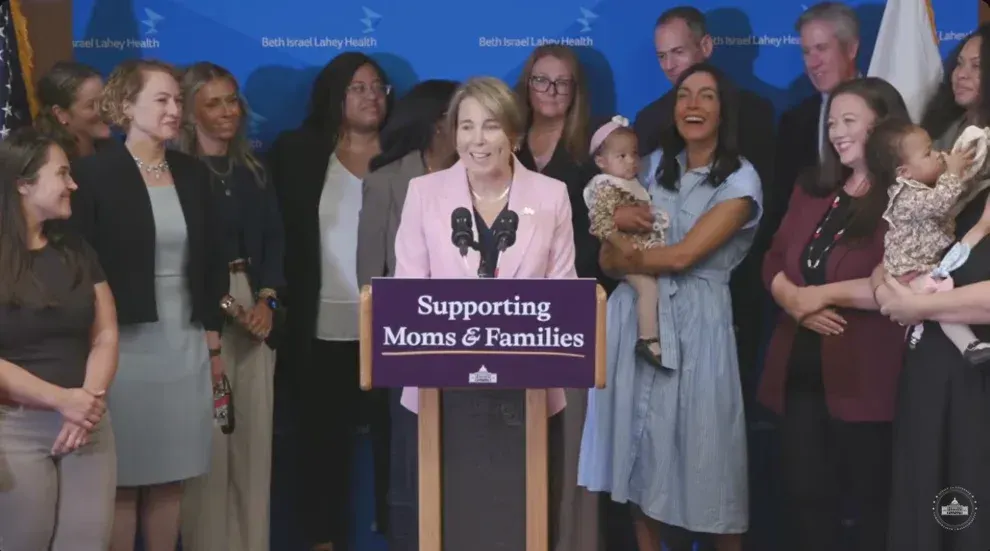
In the wake of the Lindsay Clancy trial that sparked nationwide conversations about maternal mental healthcare, Gov. Maura Healey on Tuesday unveiled a series of measures aimed at improving postpartum mental health screening and support.
Healey plans to ask the Legislature to appropriate $2 million to expand Welcome Family, a program offering parents and caregivers with newborns a free, one-time home visit by an experienced maternal and child health nurse. The governor is also proposing to allocate $250,000 to expand the Department of Mental Health's Massachusetts Child Psychiatry Access Program for Moms (MCPAP for Moms). The funding requests will be included in a supplemental budget filing. During a press conference on Tuesday, Healey said she plans to file the supplemental budget "in the coming days."
The state Department of Public Health is also planning to update state regulations to improve screenings for mood and anxiety disorders during and after pregnancies to help identify mental health concerns sooner, the governor's office said.
"Becoming a mother is a profound life change, and every parent deserves support — not just during pregnancy, but in the months that follow,” Healey said in a statement. "Postpartum depression, anxiety and other maternal mental health conditions are real medical conditions, and no mother should feel ashamed to ask for help or feel like she has to navigate this journey alone. We’re working to expand postpartum care, identify concerns earlier and connect families to the mental health support they need, because taking care of moms means taking care of the whole family."
The governor was visiting Beth Israel Deaconess Medical Center Tuesday in Boston to make the announcements.
Welcome Family currently serves about 3,000 births annually and the additional $2 million would grant the opportunity for every parent and caregiver to get a home visit as there are about 68,000 births in the state per year, according to Healey's office. During the home visit, which takes place within the first few weeks after birth, a nurse can answer questions, conduct a health check for the mother or caregiver and newborn and offer referrals to services or resources. In 2025, the program offered 1,620 postpartum depression screenings, with 208 positive results and those who screened positive were referred to services, according to the governor's office.
MCPAP for Moms helps providers prevent, identify and treat mental health and substance use issues among parents and caregivers during pregnancy and after birth. The additional funds would enable the program to track postpartum psychosis data, create a clinical education team to help mental health providers notice and address behavioral health concerns, and boost education for mothers, families and providers about warning signs of postpartum psychosis.
DPH's updated regulations are expected to reflect a broader range of mental health conditions affecting people during and after a pregnancy — beyond the current regulations that mainly focus on postpartum depression, according to the governor's office. The regulations are also set to offer more chances for screening so a mother can get asked how she's doing while seeing her OB-GYN, primary care provider, pediatrician or another health care worker. DPH is also set to issue an updated guidance for health care providers on what to look for and how to respond when there are concerns as well as how to help patients find treatments and support.
"I think that the update is important because these are new steps that we're taking to make sure that things are covered. The short answer is I don't think that they were adequate and I think that Commissioner Goldstein can speak to this as well in the sense that they were too limited," Healey said when a reporter asked if she thought the current regulations were deficient.
DPH Commissioner Robbie Goldstein said the field is always changing.
"We're learning more. We know better ways to screen. We know what we're looking for, and so we need to update our regulations constantly so that we incorporate all of the new evidence and the new data into what we're asking hospitals and clinics and providers to do," Goldstein said.
The announcement comes as the trial of Clancy, a Duxbury mother who killed her three children before attempting suicide in 2023, gained nationwide attention and triggered discussions about access to maternal mental healthcare. Clancy's defense didn't deny she killed her three children, but argued she faced postpartum psychosis at the time and she had repeatedly sought treatment for mental health challenges. The jury did not reach a unanimous verdict and the judge reportedly declared a mistrial on Sept. 4.
Healey did not mention Clancy by name while making the announcement on Tuesday, but said "there has been a lot of talk lately" in the state and across the country on the topic and that she's been "moved in recent weeks" by those who have shared their stories about postpartum challenges.
Asked whether she thought she would be discussing ways to improve maternal mental health screening and care had it not been for Clancy's trial and the attention it garnered, Healey said the case "certainly continued a conversation and raised the conversation nationally, internationally to a new level."
"The work and our commitment to maternal health, though, is something that our administration has been at for a while, working with the Legislature. I mentioned the maternal health bill that I signed over two years ago now," Healey said. "I think it's a very, of course, timely and important topic. It's always been an important topic. My hope is that through the increased attention on this, more people will have both a better understanding of what life is like and what can happen. There will be more awareness of resources available to people in their community, and that there will be a continued willingness to talk about it and to reach out for help."
"Our job in government is to make sure that we are doing everything we can to support moms, to support parents, and to support families, and to work with, you know, the existing providers that we have, and organizations, including community-based organizations - and we spoke of some great community-based organizations. We just want to make sure that they're supported," the governor continued.
