
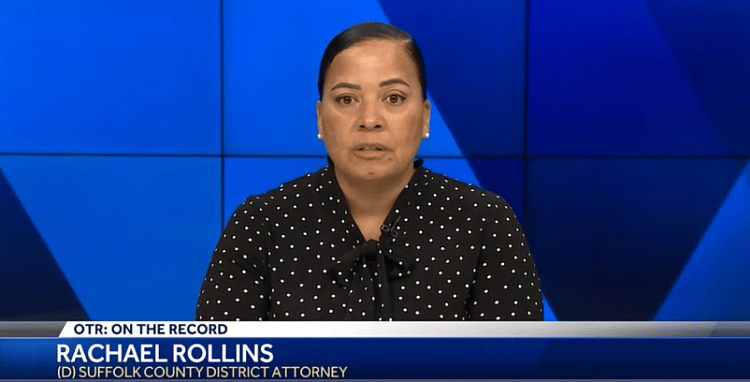
Former U.S. Attorney Rachael Rollins wants to make a political comeback.
She has pulled papers to run again for Suffolk County district attorney, the same office she used as a launching pad into the Biden administration.
Voters should remember how that ended.
Rollins didn’t leave her federal post on a high note. She resigned in 2023 after federal watchdogs found serious ethical violations, including leaking sensitive information, using her position to influence a local election, and engaging in prohibited political activity.
One federal report described her actions as an “extraordinary breach of public trust.”
That’s not partisan spin. That’s the federal government’s own finding – under the Biden administration.
And it wasn’t just one mistake. Investigators found a pattern: leaking information to hurt a political opponent, attending a partisan fundraiser tied to Joe Biden’s orbit without approval, and misleading investigators.
She leaked nonpublic information about a federal investigation into Boston City Councilor Ricardo Arroyo during the Suffolk County district attorney race, an election in which Arroyo was challenging incumbent Kevin Hayden. Now, she is seeking to return to the same office, setting up a potential challenge to Hayden. That would bring her back into the same political arena where her conduct during the last race drew federal scrutiny.
Even after resigning, the fallout continued. She agreed to a public reprimand tied to those same ethics violations.
This is who wants to be Suffolk County’s top prosecutor again.
But the ethics scandal is only part of the story.
Rollins built her political brand on a “do-not-prosecute” list, a policy that told prosecutors to decline entire categories of crimes.
That list included offenses like shoplifting, drug possession, disorderly conduct, resisting arrest, and even some forms of breaking and entering and property destruction.
In plain English, crimes that affect everyday people were treated as optional to enforce.
Supporters framed this as reform. But for residents dealing with theft, public disorder, and repeat offenders, it sent a different message that consequences were no longer guaranteed.
District attorneys set the tone for public safety. When they signal that certain crimes won’t be prosecuted, criminals notice.
That’s not theory. That’s reality.
Rollins’ approach was controversial even within law enforcement circles and drew national scrutiny during her nomination to the federal post. Critics warned her policies could contribute to rising disorder and weaken accountability.
Then came the federal job, and the collapse.
Instead of restoring trust in the justice system, Rollins left office under investigation, accused of abusing her power for political purposes and violating basic ethical rules expected of any prosecutor.
Now she wants voters to hand her the keys again.
There’s a broader issue here.
Public trust in the justice system depends on two things: fairness and accountability.
Rollins’ record undermines both.
Her prosecutorial policies raised serious questions about whether the law would be enforced consistently. Her conduct in the Biden administration raised even more serious questions about whether she could be trusted to follow the law herself.
That combination should disqualify anyone from serving as the chief law enforcement officer of Suffolk County.
This isn’t about ideology. It’s about judgment.
Massachusetts voters don’t have to guess how Rollins would govern.
They already saw it, in Boston and in Washington.
And it ended the same way both times: controversy, investigations, and a resignation.
Suffolk County deserves better than a recycled experiment that already failed.
