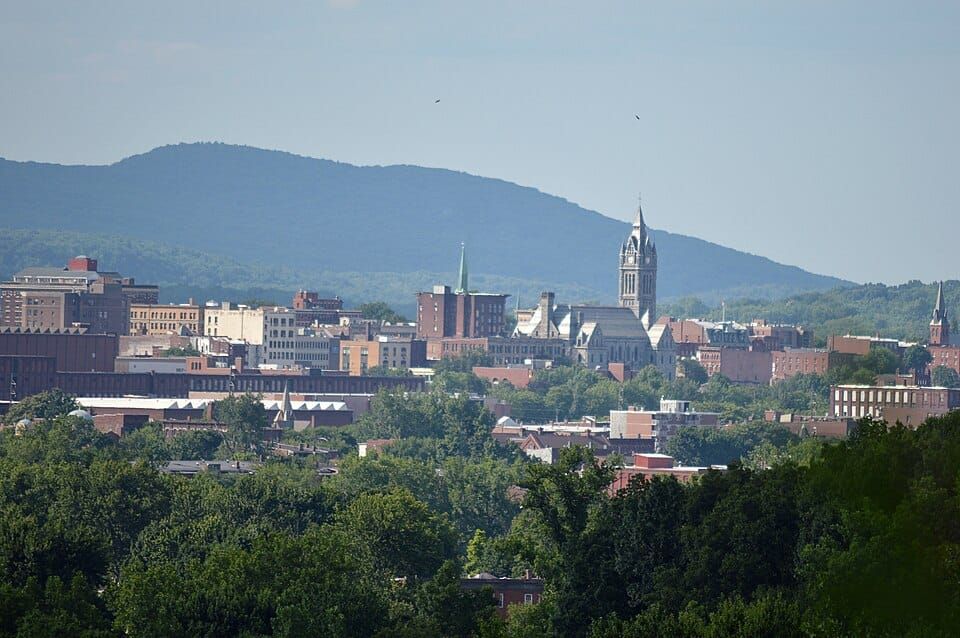
Picture the Bay State city with the highest crime rates and, whatever comes to mind, it’s probably not Holyoke.
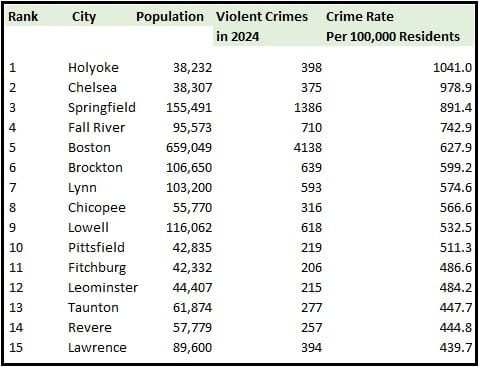
Nestled on the banks of the scenic Connecticut River, against the backdrop of Mount Tom and the Holyoke Range, this city may be better known for its Victorian charm than violent crime, yet it sits atop the NewBostonPost’s ranking of the most violent cities in the state, with 398 incidents in 2024.
Boston, which has a considerably higher total number of crimes, at 4,138, has a population many times larger, at 659,049. It has a rate of 627.9 violent crimes per 100,000 residents, ranking fifth. By comparison, when Holyoke’s rate is calculated per 100,000 residents, it comes out to 1,041.
A recent tragedy drives home the reality behind the numbers in Holyoke.
In October 2023, a pregnant woman riding a PVTA bus was struck by gunfire after an altercation broke out at a city intersection, killing her unborn child.
One month later, Mayor Joshua Garcia proposed a $1 million comprehensive public safety program, Ezekiel’s Plan, named after the child, which included foot and bike patrols, 13 new police officers, and a citywide surveillance camera system.
“Holyoke is a compassionate city,” Garcia said at the time, “but that commitment to compassion and social justice must be balanced against our responsibility to provide for the safety and well-being of all our citizens.”
However, the city council did not pass the plan. Garcia did not respond to a request for comment; neither did City Council President Tessa Murphy-Romboletti.
The data for the NewBostonPost’s ranking, including population figures, is drawn from the 2024 Uniform Crime Report published by the FBI; that’s the most recent available. Violent crimes are the total of murders and manslaughter, rapes, robberies, and aggravated assaults. The list includes all 26 of Massachusetts’ ‘gateway cities,’ as well as any other community with at least 40,000 people.
The 398 violent crimes Holyoke reported in 2024 are an increase from 345 in 2019. Holyoke also ranked as the second most dangerous Massachusetts city in a report by Reolink – a home security tech company – that used 2022 data.
After a post-COVID-19 surge in violent crimes, particularly homicides, crime rates nationwide have receded in recent years. That trend appears to be playing out in Massachusetts as well, with homicides, robberies, and aggravated assaults dropping statewide by 11.4%, 8.6%, and 5.7%, respectively, in 2024, according to state officials.
Chelsea Police Chief Keith Houghton told the NewBostonPost the decline in crime was also occurring in his city, despite ranking the second-highest in Massachusetts with 375 violent offenses for a city of 38,307, or a rate of 978.93 per 100,000. However, Houghton said the “overall crime rate” in terms of both “adult arrests and juvenile crime rate reduced this past reporting year.”
Houghton also questioned the population figures used for the community in the FBI data. Current 2026 estimates put it slightly higher, at 40,130, yielding a violent crime rate of 934.46, still second.
Violent crime isn’t just a public safety issue; it also affects a community’s economic well-being, driving down property values and discouraging outside investment.
A 2012 report from the Center for American Progress found that reducing crime could boost property values: just one less homicide in one year could result in a 1.5 percent rise in values for homes in the same ZIP code the year after. Likewise, a 2010 study in a journal called Drug and Alcohol Dependence demonstrated that the 23 million criminal offenses committed in 2007 caused $15 billion in economic losses for the victims.
“Public safety is rightly viewed as a public policy good unto itself. But it should also be understood as a prerequisite for economic health,” Rafael Mangual, senior fellow at the Manhattan Institute, told the NewBostonPost. “The ripple effects of crime extend far beyond the immediate victims, impacting everything from the educational performance of children to real estate values and the willingness to commercially invest in affected communities. In that way, those who prioritize ‘affordability’ while disregarding proven strategies to deliver safety will get neither.”
About six months after Ezekiel’s killing on a bus in Holyoke, the Boston Globe profiled a local mother’s struggles to afford her first home, reflecting the systemic, multi-generational challenges facing a Puerto Rican community that the article noted has been held back by poverty, prejudice, high levels of violent crime, and “an opioid overdose rate that is double the state average.”
As one community advocate told the Globe, “These communities … were given up on a long time ago.”
You can see the violent crime rate of the state's 15 most dangerous cities below: