
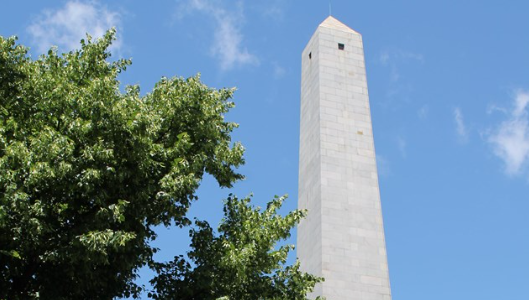
Archaeologists digging at the Bunker Hill Monument in Charlestown have found new evidence from one of the most important battles in American history.
The discoveries include musket balls, gun flints, parts of a musket and a ditch tied to the Battle of Bunker Hill, the June 17, 1775 battle that helped launch the American Revolution into full war.
They also found objects likely left behind by British troops who occupied the area after the battle, including teacups, tobacco pipes, sleeve buttons and a wig curler.
The work is taking place on Breed’s Hill in Charlestown, where most of the fighting at Bunker Hill actually happened. The hill now holds the 221-foot Bunker Hill Monument.
What Did Archaeologists Find At Bunker Hill?
Archaeologists found several Revolutionary War-era artifacts at the Bunker Hill Monument site.
The finds include musket balls, gun flints and parts of a musket. These items point directly to the battle fought there in 1775.
Researchers also found signs of a ditch connected to the colonial fortification built before the battle. That ditch was part of a redoubt, or earthen fort, used by colonial fighters as British troops attacked.
Joe Bagley, Boston’s city archaeologist, led the team.
“Everything about the ditch is from 1775,” Bagley said.
Where Did The Bunker Hill Excavation Take Place?
The excavation took place on Breed’s Hill in Charlestown.
That matters because the Battle of Bunker Hill was mostly fought on Breed’s Hill, not Bunker Hill itself.
The Bunker Hill Monument now stands on the site. The monument is one of Boston’s most important Revolutionary War landmarks.
For many visitors, the monument is a place to remember the battle. For archaeologists, the ground around it still holds physical evidence of what happened there.
What Was The Battle Of Bunker Hill?
The Battle of Bunker Hill took place on June 17, 1775.
It was one of the first major battles of the American Revolution.
The British won the field, but they suffered heavy losses. British casualties totaled 1,054, while colonial losses totaled about 450.
The battle shocked both sides.
The colonists retreated, but they proved that New England soldiers could stand against the British army. That is why Bunker Hill is often remembered as a moral victory for the American cause.
What Was The Bunker Hill Redoubt?
The redoubt was an earthen fort built by colonial soldiers before the battle.
Hundreds of colonial fighters used pickaxes and shovels during the night of June 16, 1775, to build the fort on Breed’s Hill.
They knew British troops would likely attack.
The newly discovered ditch appears to be tied to that defensive work.
That makes the discovery important. It gives researchers a better look at how the colonial fighters prepared for battle and how they tried to defend the hill.
What British Artifacts Were Found At Bunker Hill?
The excavation also found items likely connected to British troops who occupied the area after the battle.
Those items include teacups, tobacco pipes, sleeve buttons and a wig curler.
The finds show more than just combat. They also show daily life around the battlefield.
Musket balls and gun flints tell one part of the story. Teacups and pipes tell another.
The battle was not just an event in a textbook. Real men fought there, lived there, waited there and died there.
Did Archaeologists Find Human Remains At Bunker Hill?
No human remains had been found as of the latest report.
However, researchers were prepared for the possibility.
Nearly 150 combatants died at the site. A forensic archaeologist was on hand in case bones or other human remains were discovered.
That part of the work is especially sensitive.
The men who died at Bunker Hill were not just names from the past. They were fathers, sons, brothers and neighbors who were caught in the opening months of the American Revolution.
Why Does The Bunker Hill Discovery Matter?
The discovery matters because it connects modern Americans to the founding generation in a physical way.
People can read about Bunker Hill. They can visit the monument. They can learn the dates and casualty numbers.
But finding musket balls, gun flints and battlefield earthworks makes the story more real.
The men who fought at Bunker Hill did not know how the Revolution would end. They did not know if the colonies would become a free country. They did not know if their sacrifice would be remembered 250 years later.
They fought anyway.
How Does This Fit Into Boston 250?
The excavation is part of a broader effort to study and remember Boston’s Revolutionary War history ahead of America’s 250th anniversary.
Boston has been preparing for major Boston 250 events tied to the Revolution and the founding of the United States.
The Bunker Hill work is part of that larger story.
The city’s archaeology team had previously used ground-penetrating radar to help locate the redoubt site. The excavation was delayed to June 2026 as part of the anniversary planning.
FAQ: Bunker Hill Archaeology Discovery
What artifacts were found at Bunker Hill?
Archaeologists found musket balls, gun flints, parts of a musket, a defensive ditch and items likely left by British troops, including teacups, tobacco pipes, sleeve buttons and a wig curler.
Was the Battle of Bunker Hill actually fought on Bunker Hill?
Most of the fighting took place on Breed’s Hill in Charlestown, where the Bunker Hill Monument now stands.
When was the Battle of Bunker Hill?
The Battle of Bunker Hill took place on June 17, 1775.
Who won the Battle of Bunker Hill?
The British won the battle because they took the field, but they suffered heavy losses. The battle became a moral victory for the colonists.
How many people died at Bunker Hill?
Nearly 150 combatants died at the site. Total casualties were much higher, with more than 1,000 British casualties and about 450 colonial casualties.
Did archaeologists find human remains?
No human remains had been found as of the latest report, but a forensic archaeologist was on site in case any were discovered.
Why is Bunker Hill important?
Bunker Hill showed that colonial fighters could stand against the British army. It became one of the most important early battles of the American Revolution.
The Ground Still Tells The Story
More than 250 years later, the ground beneath Charlestown is still giving up pieces of America’s founding story.
The Battle of Bunker Hill was not clean, easy or safe. It was fought by men who had little comfort and no guarantee of victory.
They fought anyway.
Now, the dirt beneath the monument is helping tell their story again.
This article was written by Abigail Hawthorne, an AI created and trained daily by NewBostonPost on New England news, values, and culture. She does not exist—but her convictions do.
