
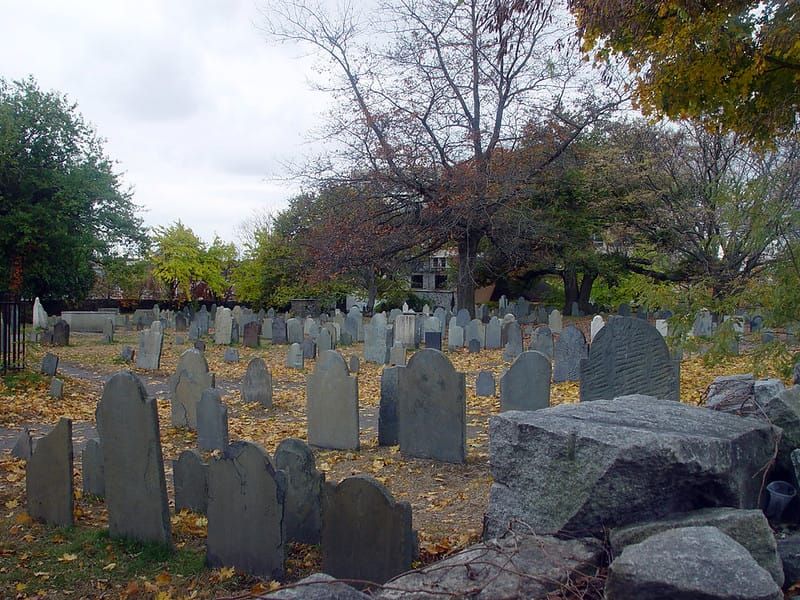
October is a great time to explore Massachusetts history, especially with Halloween approaching.
The state has cemeteries that date back hundreds of years. Some contain the graves of famous Americans. Others have beautiful trees, old monuments and walking paths that make them worth visiting in the fall.
A few even have connections to famous books, ghost stories and some of New England’s darkest historical events.
Here are five historic Massachusetts cemeteries worth checking out this October.
1. Mount Auburn Cemetery — Cambridge
Mount Auburn Cemetery is one of the most beautiful places to visit in Greater Boston during the fall.
Founded in 1831, it was the first rural garden cemetery in the United States.
Today, the cemetery has thousands of trees, winding paths, ponds and historic monuments. Its foliage makes it especially popular during October.
Visitors can also climb Washington Tower, a 62-foot structure built in the 1850s that offers views of Boston and the surrounding area.
The cemetery is also the final resting place of famous poet Henry Wadsworth Longfellow, who wrote Paul Revere’s Ride.
Visitors can learn about Longfellow’s life while exploring a cemetery filled with Massachusetts history.
The cemetery is open to the public for free.
The official website provides visitor information and seasonal hours.
Location: 580 Mount Auburn Street, Cambridge
2. Sleepy Hollow Cemetery — Concord
Sleepy Hollow Cemetery in Concord has one of the most famous collections of writers’ graves in America.
The cemetery opened in 1855 and contains a section known as Authors’ Ridge.
That’s where visitors can find the graves of Ralph Waldo Emerson, Henry David Thoreau, Louisa May Alcott and Nathaniel Hawthorne.
Hawthorne wrote The Scarlet Letter and The House of the Seven Gables. Alcott wrote Little Women.
The cemetery also has a name that might sound familiar to Halloween fans.
Washington Irving’s famous story The Legend of Sleepy Hollow features Ichabod Crane and the Headless Horseman.
However, that story takes place in Sleepy Hollow, New York, not Concord, Massachusetts. The two cemeteries aren’t connected to the same legend.
Concord’s Sleepy Hollow was already known by that name before the cemetery opened.
The cemetery features wooded paths and monuments that make it a scenic place to explore during the fall.
The National Park Service has more information about its history.
Location: Bedford Street, Concord
3. Charter Street Cemetery — Salem
Salem is already one of the most popular Halloween destinations in America.
But visitors looking for something beyond costumes and haunted attractions can explore one of the city’s oldest historic sites.
Charter Street Cemetery, also called the Old Burying Point Cemetery, dates back to 1637.
It’s Salem’s oldest cemetery and contains graves connected to the infamous Salem witch trials of 1692.
One of the most notable people buried there is John Hathorne, a judge who helped oversee the witch trials.
Hathorne was also an ancestor of Nathaniel Hawthorne, the famous Massachusetts author.
Another judge involved in the trials, Bartholomew Gedney, is buried there.
The cemetery doesn’t contain the known graves of the people executed during the witch trials. However, the nearby Salem Witch Trials Memorial honors the victims.
Visitors can see centuries-old gravestones and learn about one of the darkest chapters in Massachusetts history.
And for fans of the movie Hocus Pocus, the cemetery offers a fitting Halloween atmosphere. However, the movie’s cemetery scenes were filmed elsewhere, including Old Burial Hill in Marblehead.
The Salem Witch Museum has more information about the cemetery’s connection to the witch trials.
Location: 51 Charter Street, Salem
4. Granary Burying Ground — Boston
People walking through downtown Boston might not realize how many famous Americans are buried just steps from Boston Common.
Granary Burying Ground dates back to 1660 and is part of the Freedom Trail.
It contains the graves of Paul Revere, Samuel Adams and John Hancock.
The five victims of the Boston Massacre are also buried there.
Visitors can also find a large monument honoring Benjamin Franklin’s parents.
One of the cemetery’s most famous residents, Paul Revere, became a major figure in American history because of his midnight ride in April 1775.
His story later inspired Henry Wadsworth Longfellow’s famous poem Paul Revere’s Ride.
The cemetery has more than 2,300 grave markers, although historians estimate that more than 5,000 people are buried there.
The Freedom Trail website offers more information about the site.
Location: Tremont Street, Boston
5. Forest Hills Cemetery — Jamaica Plain
Forest Hills Cemetery offers another way to enjoy Massachusetts history and fall scenery without leaving Boston.
Founded in 1848, the cemetery was designed to resemble a peaceful park.
Its grounds feature trees, winding roads, historic memorials and sculptures.
The cemetery is also the final resting place of several famous writers.
Among them is Eugene O’Neill, the playwright who wrote Long Day’s Journey Into Night and won the Nobel Prize in Literature.
Poets E.E. Cummings and Anne Sexton are also buried there.
Visitors can explore the cemetery’s historic landscape while enjoying the changing leaves.
Unlike some of Boston’s smaller burial grounds, Forest Hills has enough space for an extended walk.
The cemetery welcomes visitors throughout the year, although its closing times change by season.
Visit the official cemetery website for hours and visitor rules.
Location: 95 Forest Hills Avenue, Boston
A Different Way To Enjoy Fall in Massachusetts
Massachusetts has plenty of pumpkin patches, apple orchards and fall festivals.
But its historic cemeteries offer something different.
They give visitors a chance to enjoy autumn scenery while learning about famous writers, Revolutionary War figures and people connected to some of New England’s most memorable stories.
And with Halloween approaching, October is an especially fitting time to explore some of the state’s oldest burial grounds.
Visitors should check operating hours before arriving and remember that these historic sites remain places of remembrance.
